By Earl Dalton, MHA, MSL, RN, NEA-BC, FAAN, Chief Clinical Officer
Based on 1,300+ evaluations by nurse leaders over five years, international nurses are rated average or better 97%+ of the time across clinical skills, communication, teamwork, safety, and attendance. More than one-third are rated excellent. The data consistently shows that performance concerns common in pre-hire conversations don't materialize in practice — what actually drives long-term outcomes is how well organizations support nurses through integration, not whether they can perform.
97%+ of international nurses are rated average or better by the nurse leaders who actually supervise their work. More than a third are rated excellent.
That's not a marketing claim — it's the finding from our latest Nurse Impact Report, based on 1,300+ nurse leader evaluations collected over five years from the people directly responsible for patient care. In conversations with hospital leaders, questions about international nurses still tend to center on performance, integration, and predictability. But across the data, those concerns simply aren't reflected in the outcomes.
What stands out to me is that while transition challenges do exist — particularly around technology workflows, communication norms, and adapting to U.S. care environments — those concerns are not translating into poor performance outcomes once nurses are properly supported within care teams.
“The performance question has been answered. The difference now is how organizations support that performance to drive long-term workforce stability.”
International Nurse Performance Data: What 1,300+ Hospital Evaluations Actually Show
Healthcare leaders evaluating international nurses often focus on potential risks — clinical quality, communication, and team integration. This analysis reflects how international nurses are actually performing in U.S. hospitals, based on direct evaluation from nurse leaders managing patient care.
At the highest level, two numbers tell most of the story:
- 97%+ — rated average or better, consistently, across the full five-year evaluation window.
- One-third+ — rated Excellent, reflecting top-tier clinical performance, not just adequate performance.
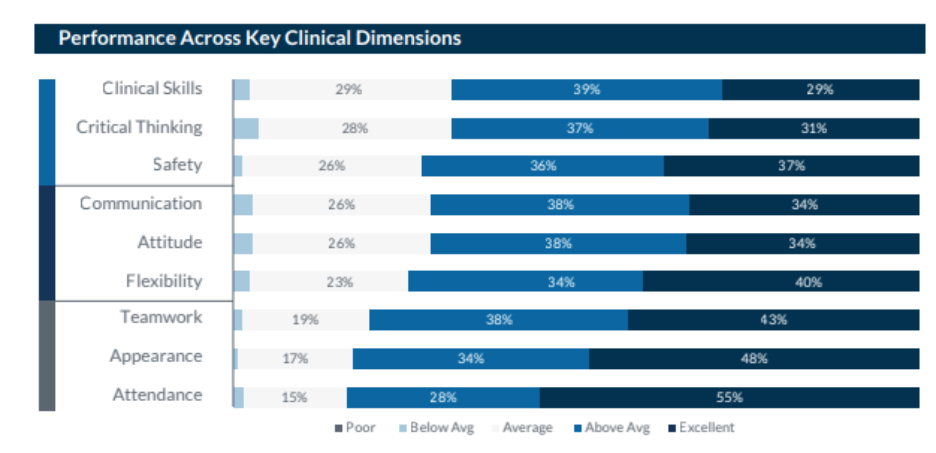
Across all nine dimensions measured — clinical skills, critical thinking, safety, communication, attitude, flexibility, teamwork, appearance, and attendance — international nurses are rated at or above expectations by the nurse leaders directly observing their work. The data shows the strongest results in attendance (55% excellent), teamwork (43% excellent), and flexibility (40% excellent), with clinical skills, safety, and critical thinking also rating in the top third at the excellent level. In no category did the data reveal a pattern of underperformance. Performance concerns raised before hire simply don't show up after placement.
Why International Nurse Clinical Performance Holds Up — and What Makes It Sustainable
Performance like this doesn't start at the point of arrival — it reflects how well nurses are prepared before they begin, how they are supported as they transition into a new environment, and how consistently that support continues over time.
One of the most common gaps in international staffing strategies is treating arrival as the milestone. In practice, that's where adaptation to new technology systems, communication expectations, and workplace culture begins.
A structured workforce model connects the full nurse journey — from preparation through long-term retention — including onboarding support, cultural integration, and transition guidance delivered in practice. When that continuity is in place, outcomes become more consistent. Early performance stabilizes, integration improves, internal strain on nurse leaders is reduced, and long-term retention strengthens.
That journey typically spans five connected stages:
- Candidate Sourcing
- Assignment Preparation
- At Arrival
- On Assignment
- Retention & Conversion
The question is no longer whether international nurses can perform. It's whether the organization has a model in place that supports that performance from readiness through retention — and sustains it over time.
What This Means for Hospital Workforce Strategy
International staffing is often evaluated based on access to talent, but the real opportunity is not access — it's stability. The data is clear and the performance is proven: international nurses are a reliable, high-performing part of the workforce.
The differentiator is not the talent itself — it is how that talent is prepared, supported, and integrated into U.S. clinical and workplace environments to deliver consistent, long-term results.
Frequently Asked Questions
Do international nurses perform as well as domestic nurses in U.S. hospitals?
Based on direct evaluation from nurse leaders across 1,300+ assessments over five years, international nurses are rated average or better 97%+ of the time across clinical skills, communication, teamwork, safety, and attendance. More than one-third are rated excellent. The data does not support the concern that international nurses underperform compared to domestic counterparts when properly supported.
What clinical areas do international nurses perform best in?
According to nurse leader evaluations, international nurses show particularly strong performance in attendance (55% rated excellent), teamwork (43% rated excellent), and flexibility (40% rated excellent). Clinical skills, critical thinking, and safety all rate in the top third at the excellent level as well. No performance category showed a pattern of underperformance across the five-year evaluation window.
What are the biggest challenges international nurses face when starting in U.S. hospitals?
The most common transition challenges involve adapting to U.S.-specific technology workflows and electronic health record systems, adjusting to local communication norms and documentation expectations, and navigating new workplace culture dynamics. These challenges are temporary and typically do not translate into performance problems when nurses are supported through a structured onboarding and integration program.
How does onboarding support affect international nurse clinical performance?
Structured pre-arrival preparation and post-arrival onboarding support directly improves early performance stability, communication confidence, and team integration speed. Organizations that treat arrival as the starting point — rather than preparation — consistently see more friction, slower integration, and higher early attrition than those with connected, end-to-end support models.
How long does it take for international nurses to fully integrate into a U.S. hospital team?
Integration timelines vary based on the level of pre-arrival preparation, the quality of onboarding support, and the intentionality of the clinician-unit match. With a structured workforce model that connects preparation, arrival, and on-assignment support, most international nurses reach full team integration within their first assignment period — and remain at high retention rates through conversion to permanent employment.
About the Author
Earl Dalton, MHA, MSL, RN, NEA-BC, FAAN, is Health Carousel's Chief Clinical Officer, with 30+ years of experience leading clinical operations and advancing workforce quality across healthcare systems.


Earl Dalton